
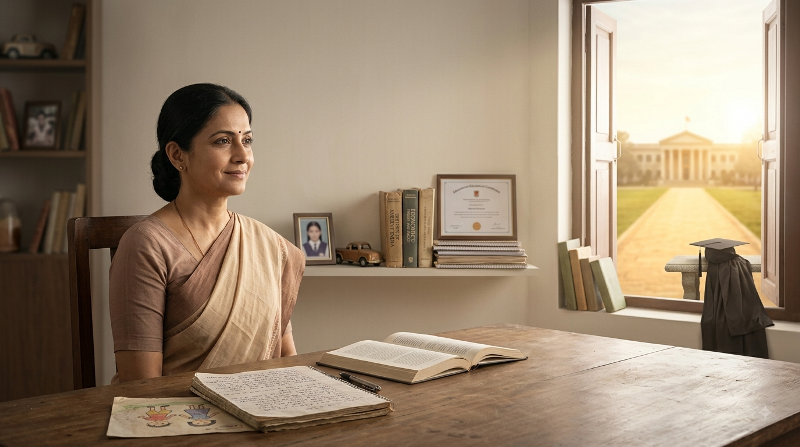
There comes a season in many homes when silence arrives without warning. It settles gently upon walls once alive with hurried footsteps, laughter, forgotten toys, examination timetables, and endless conversations between a mother and her children. The rooms remain unchanged, yet something immeasurable has departed. The children, having outgrown the shelter of home, leave in pursuit of their own destinies, carrying with them the dreams their parents carefully nurtured. The house grows still, and in that stillness a woman often encounters a voice she has not heard for many years—her own.
It is a moment that society rarely acknowledges. Much has been written about motherhood, sacrifice, and devotion, but far less about the invisible cost these virtues sometimes demand. A woman’s life is often celebrated for the love she gives, yet seldom examined for the dreams she quietly postpones. Among the many issues confronting women today, one remains remarkably understated: the expectation that her aspirations must wait while every other life entrusted to her moves forward.
A girl begins life with ambitions no different from those of her brothers. She dreams of universities, laboratories, concert halls, courtrooms, hospitals, studios, and classrooms. She is encouraged to excel, applauded for her achievements, and assured that education will shape her future. Yet somewhere between youthful promise and adult responsibility, the language surrounding her changes. Achievement gradually yields to adjustment. Personal ambition quietly gives way to domestic expectation. Without formal decree or deliberate coercion, she learns that the fulfilment of others often requires the postponement of herself.
Marriage is not the adversary of a woman’s dreams, nor is motherhood. Both possess profound dignity and immeasurable beauty. The injustice lies elsewhere. It lies in the deeply rooted assumption that family responsibilities should naturally eclipse a woman’s intellectual and personal aspirations, while the ambitions of others continue uninterrupted. What should provoke reflection instead becomes tradition.
The years that follow are filled with purpose. She becomes the first teacher her children ever know, introducing them to language, kindness, discipline, and hope. She remains awake through nights of illness, celebrates every small triumph, and stands steadfast through every disappointment. School admissions, examinations, graduations, and careers become chapters of a story she helps to write with unwavering devotion. In nurturing countless possibilities for those she loves, she rarely notices that one possibility has quietly receded into the background—her own.
The world often mistakes silence for contentment. Because she seldom complains, it is assumed that nothing has been lost. Yet many women carry unfinished conversations with their younger selves. An incomplete degree, an abandoned research proposal, a manuscript left unwritten, an instrument untouched for years, or a profession relinquished in the name of necessity becomes more than an interrupted ambition. It becomes a fragment of identity quietly preserved beneath the ordinary rhythms of everyday life.
This is not merely an individual experience; it is a social reality shared by countless women across cultures and generations. Educational opportunities have expanded considerably, yet many women continue to suspend those opportunities indefinitely. The interruption is seldom dramatic. It occurs quietly until months become years and years become decades. Society applauds the sacrifice while forgetting to ask whether it should have been expected at all.
Then, one day, the house grows quiet.
The lunch boxes are no longer prepared before dawn. School uniforms disappear from the clothesline. The constant calls of “Mother” become occasional telephone conversations from distant cities. She stands before a shelf crowded with old books and certificates, each bearing witness to a dream that time postponed but never extinguished. She opens a notebook and encounters not merely faded handwriting but the person she once believed she would become.
For the first time in many years, she asks herself a question she had long considered impossible.
What if it is not too late?
The question is neither impulsive nor born of regret. It arises from memory. Beneath the many roles she has embraced still resides the woman who delighted in learning, who believed knowledge was not merely a path to employment but a way of understanding both the world and herself. Dreams possess remarkable resilience. They may retreat into silence, yet they seldom surrender. They wait patiently for the moment when courage welcomes them home.
Here the true nature of the issue reveals itself. A woman should not have to reclaim what ought never to have been relinquished. The opportunity to pursue education, scholarship, or a cherished vocation should not depend upon the completion of every domestic responsibility. When society accepts without question that women must defer their aspirations until their children have grown, it silently establishes an unequal measure of expectation. A mother’s devotion deserves reverence, but it should never require the extinction of her individuality.
The women who return to classrooms after decades of absence often carry invisible burdens. They fear unfamiliar technology, changing academic practices, and beginning again among students young enough to be their own children. More difficult still is the fear of judgement. Yet they persevere. Every page they read, every assignment they complete, and every examination they face affirms that the human mind recognises no age limit.
Their return to education is often mistaken for the pursuit of a qualification. In truth, it is the restoration of identity. The certificate they eventually receive signifies far more than academic success. It represents perseverance over resignation, conviction over doubt, and hope over silence. It reminds them that they are not defined solely by the lives they have nurtured but also by the aspirations they continue to honour.
Their influence extends far beyond themselves. Their children witness something profoundly transformative. The mother who once encouraged them to complete homework now prepares for examinations of her own. In watching her persevere, they learn that education is not confined to youth and that self-fulfilment is neither vanity nor selfishness. They discover that love does not require the abandonment of one’s identity. Rather, families flourish most beautifully when every member is encouraged to grow.
Communities, too, bear a responsibility. Educational institutions must welcome women whose studies were interrupted by circumstances beyond their control. Families should celebrate, rather than question, a mother’s decision to return to education. Lifelong learning and flexible opportunities are not merely educational initiatives; they are affirmations of equality.
When she finally walks across a graduation stage, she carries far more than a degree. She carries the quiet triumph of every woman who refused to believe that time had rendered her dreams irrelevant. She stands as living testimony that postponed aspirations need not become forgotten aspirations.
The silence that once filled her home has given birth to another beginning. The nest may have grown quiet, but within that quietness another life has awakened, one that had waited patiently for its rightful season. The world should not ask why she chose to begin again. It should ask why she was ever expected to wait.
For no woman’s dream should be measured by the years she surrendered to love, but by the courage with which she chooses, at last, to reclaim it.