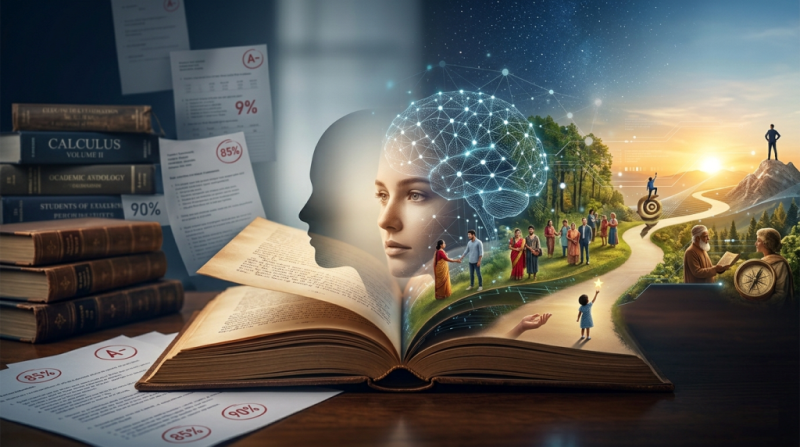
In today’s academic environment, success is often measured by percentages, grades, and placements. Students frequently approach books with a single objective, to prepare for examinations and secure high marks. While academic achievement is undoubtedly important, limiting reading to the pursuit of scores deprives learners of one of literature’s greatest gifts: the opportunity to discover themselves.
Literature is far more than a prescribed syllabus. It is an invitation to reflect, question, imagine, and grow. Every novel, poem, play, and short story offers not merely a narrative but an encounter with life in its countless forms. It encourages readers to move beyond memorisation and embark upon a deeply personal journey of self-discovery.
The true value of literature lies not in how many texts one has completed but in how profoundly those texts transform one’s perspective. A reader may forget the sequence of events in a novel, yet remember forever the courage of a character, the wisdom hidden in a dialogue, or the hope found in a seemingly ordinary moment. Such experiences become part of one’s character, quietly shaping attitudes, decisions, and relationships.
Every stage of life presents questions that cannot be answered by textbooks alone. Who am I? What kind of person do I wish to become? How do I respond to failure? What is the meaning of success? Literature does not impose ready-made answers. Instead, it encourages readers to explore these questions through the lives of others. In witnessing the triumphs and struggles of fictional and real-life characters, students often discover their own strengths, fears, and aspirations.
One of literature’s most remarkable qualities is its ability to promote empathy. When readers step into the lives of people from different cultures, generations, and circumstances, they begin to understand experiences beyond their own. They learn that happiness, grief, love, loneliness, courage, and hope are universal human emotions. This ability to appreciate another person’s perspective nurtures compassion, tolerance, and emotional maturity, qualities that are as essential as academic knowledge.
Reading also develops the habit of introspection. In a world filled with constant notifications, endless scrolling, and hurried conversations, literature offers the rare opportunity to pause. It allows readers to sit quietly with their thoughts, reflect upon their experiences, and examine their beliefs. This reflective engagement strengthens self-awareness, enabling young adults to make thoughtful choices rather than impulsive decisions.
For many students, literature becomes a source of comfort during uncertain times. A poem may articulate emotions they have struggled to express. A novel may reassure them that setbacks are temporary and resilience is possible. A biography may inspire them to persevere despite obstacles. The pages of a book often become silent companions, reminding readers that they are not alone in their struggles.
Importantly, literature nurtures imagination, the foundation of creativity and innovation. Every story encourages readers to visualise unfamiliar places, understand complex emotions, and imagine possibilities beyond immediate reality. This creative engagement extends far beyond the classroom. It enriches problem-solving, communication, leadership, and decision-making, equipping students with skills that remain valuable throughout their lives.
Reading beyond marks also cultivates independent thinking. Rather than accepting ideas at face value, literature invites readers to interpret, question, analyse, and debate. Two students may read the same novel yet arrive at entirely different conclusions, each supported by thoughtful reasoning. Such intellectual freedom encourages confidence, curiosity, and respect for diverse viewpoints, qualities that define an educated mind.
For teachers, literature presents an extraordinary opportunity to shape not only competent graduates but responsible human beings. Classroom discussions should extend beyond summaries and examination questions. They should encourage students to relate literary themes to contemporary society, ethical dilemmas, personal experiences, and global challenges. When literature is taught as a living conversation rather than a static subject, learning becomes meaningful and enduring.
Educational institutions also play a significant role in cultivating a culture of reading. Literary clubs, book discussions, creative writing workshops, author interactions, poetry recitations, and storytelling sessions transform reading from an academic requirement into an enriching experience. Such initiatives inspire students to explore books voluntarily, discovering interests that may remain with them for a lifetime.
In an age increasingly influenced by artificial intelligence and digital technologies, the importance of reading assumes renewed significance. Technology can summarise a novel, explain its themes, or generate interpretations within seconds. However, it cannot replicate the deeply personal experience of discovering oneself through reading. The quiet conversation between a reader and a book remains profoundly human. It is within that intimate dialogue that transformation occurs.
Reading beyond marks also prepares students for responsible citizenship. Literature exposes readers to social inequalities, cultural diversity, environmental concerns, historical struggles, and ethical conflicts. It broadens their understanding of society and encourages them to engage with the world thoughtfully and compassionately. An informed reader is more likely to become an empathetic citizen, a responsible professional, and a conscientious leader.
Ultimately, the purpose of education extends beyond producing employable graduates. Its highest aim is to nurture individuals who possess wisdom, integrity, empathy, and the courage to contribute meaningfully to society. Literature serves this purpose with remarkable effectiveness because it speaks simultaneously to the intellect and the heart.
As educators, we must continue to encourage our students to read not merely for examinations but for enrichment. Every book they encounter has the potential to become a mentor, every poem a quiet companion, and every story a window into new possibilities. Marks may open the door to a career, but meaningful reading opens the door to a fuller understanding of life.
When students begin to read beyond marks, they discover that literature is not simply about characters on a page. It is about recognising themselves within those stories, understanding others with greater compassion, and emerging as wiser, more thoughtful individuals. In that journey of self-discovery lies the enduring power of literature and perhaps the true purpose of education itself.